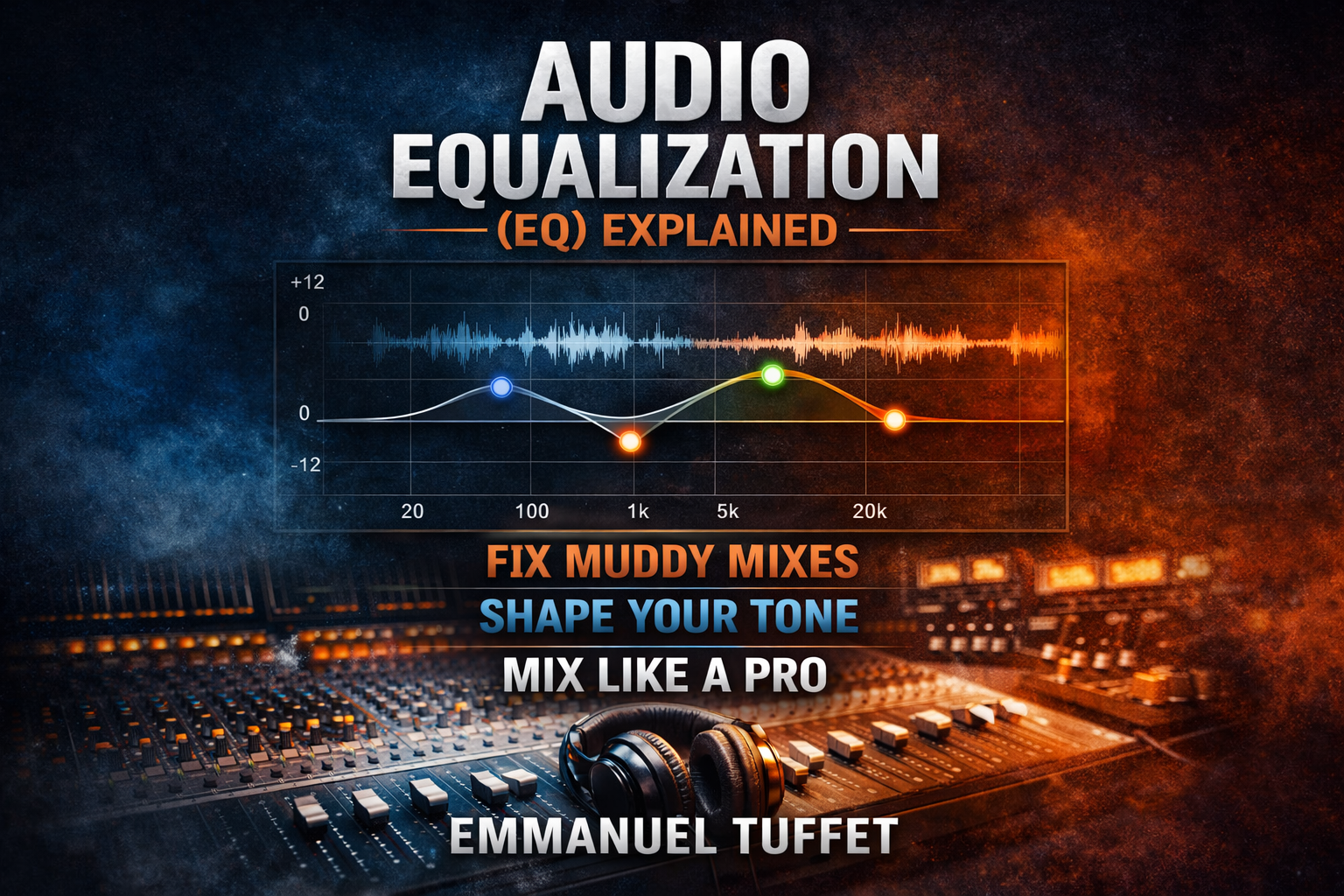
In this comprehensive course, I guide you through the essential principles and professional techniques of audio equalization (EQ)—one of the most powerful tools in music production and audio engineering.
Designed for producers, engineers, and creators at all levels, I explain how frequencies behave, how the human ear perceives sound, and how to use EQ strategically to shape tone, remove unwanted frequencies, and bring clarity to your mixes.
Through structured lessons, practical examples, and real-world mixing scenarios, I show you how professionals apply EQ to vocals, drums, bass, guitars, and full mixes. You will also explore advanced techniques such as parametric EQ control, dynamic EQ, mid-side processing, and workflow optimization in modern DAWs.
By the end of this course, you will develop critical listening skills and a repeatable EQ workflow that will help you mix with greater precision, confidence, and professional-quality sound.
Emmanuel Tuffet
Course Features
- Lectures 42
- Quiz 0
- Duration 10 weeks
- Skill level All levels
- Language English
- Students 0
- Assessments Yes
- 7 Sections
- 42 Lessons
- 10 Weeks
- The Fundamentals of Sound and Frequency6
- 1.1Understanding the Nature of Sound Waves
- 1.2Decibels (dB) and Amplitude Explained
- 1.3The Human Auditory System and Frequency Perception
- 1.4Introduction to the Frequency Spectrum (20Hz – 20kHz)
- 1.5Identifying Key Frequency Ranges and Their Characteristics
- 1.6Case Study: Analyzing a Raw Multi-Track Session (Drums, Bass, Guitar, Vocals)
- Introduction to Equalizers and Their Types6
- 2.1What is an Equalizer and Why Do We Use It?
- 2.2Overview of Different EQ Types: Parametric, Graphic, Shelving
- 2.3Exploring Parametric EQ Controls: Gain, Frequency, Q Factor/Bandwidth
- 2.4Understanding Graphic EQs: Fixed Frequencies and Sliders
- 2.5Shelving EQs: High-Pass, Low-Pass, High-Shelf, Low-Shelf Filters
- 2.6Practical Exercise: Identifying EQ Types in a Digital Audio Workstation (DAW)
- EQ Controls and Parameters in Detail6
- 3.1Deep Dive into Frequency Selection and Its Impact
- 3.2Mastering Gain Adjustments: Boosting vs. Cutting Frequencies
- 3.3The Crucial Role of the Q Factor (Bandwidth) in Sculpting Sound
- 3.4Understanding Filter Slopes: Gentle vs. Steep Curves
- 3.5Notch Filters and Their Application in Problem Solving
- 3.6Practical Exercise: Sculpting a Bass Guitar Track with Parametric EQ
- The Art and Science of Corrective EQ6
- Creative EQ for Shaping Tone and Enhancing Mixes6
- Advanced EQ Techniques and ApplicationsMid-Side EQ for Stereo Imaging and Control6
- 7.1Mid-Side EQ for Stereo Imaging and Control
- 7.2Dynamic EQ: Bridging the Gap Between EQ and Compression
- 7.3Understanding Linear Phase vs. Minimum Phase EQs
- 7.4EQing in Different Mixing Stages: Tracking, Mixing, Mastering
- 7.5Mastering EQ: Subtle Adjustments for Final Polish
- 7.6Practical Exercise: Applying Mid-Side EQ to a Stereo Bus
- Common EQ Mistakes and Workflow Optimization6