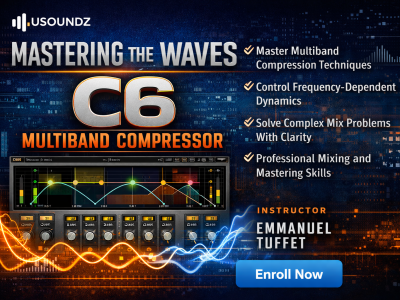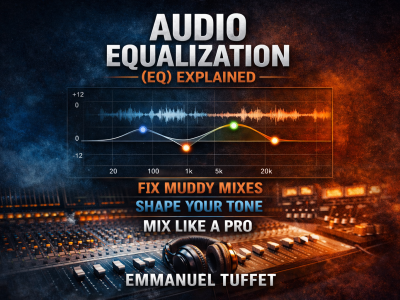
This course provides a complete, professional framework for understanding and controlling the full audible frequency spectrum used in modern music production. Designed for producers, mixing engineers, and audio students, it breaks down the spectrum into seven essential frequency zones, each representing a critical component of a clean, powerful, and well-balanced mix.
Students will learn how to identify where instruments sit within the spectrum and how to apply EQ, compression, dynamic processing, and harmonic enhancement to achieve clarity, separation, and impact. The course combines audio theory, psychoacoustics, and real-world mixing techniques, allowing learners to move beyond guesswork and make precise, intentional decisions in their mixes.
Through practical exercises and case studies, you will develop the ability to:
- Control sub-bass energy and eliminate phase issues
- Clean up muddy low-mid frequencies for better clarity
- Shape vocal presence and instrument definition
- Manage harshness and improve intelligibility
- Add brightness, air, and professional polish to your mixes
- Build a cohesive mix-bus chain that integrates all frequency zones
By the end of this course, you will be able to analyze, shape, and balance the entire 20 Hz – 20 kHz spectrum with confidence, creating mixes that translate across studio monitors, headphones, cars, and club systems.
This is not just a mixing course—it is a complete system for mastering the frequency spectrum and elevating your sound to a professional level.
Instructor: Emmanuel Tuffet
Course Features
- Lectures 42
- Quiz 0
- Duration 10 weeks
- Skill level All levels
- Language English
- Students 0
- Assessments Yes
- 7 Sections
- 42 Lessons
- 10 Weeks
- Module 1: The Sub-Bass Foundation (20 Hz – 60 Hz)6
- 1.1Physics of Infrasonic Energy and Room Mode Identification
- 1.2Calibrating Your Monitoring System for Accurate Sub-Bass Translation
- 1.3Surgical Equalization Techniques for Cleaning Up Kick Drums and Bass Synths
- 1.4Utilizing Multiband Compression to Tighten Low-End Consistency
- 1.5Analyzing the Case Study Project: Identifying Phase Cancellation in the Sub-Range
- 1.6Practical Exercise: Sidechain Compression Calibration for Sub-Bass Lockdown
- Module 2: The Bass and Power Region (60 Hz – 250 Hz)6
- 2.1Understanding Fundamental Frequencies of Rhythm Sections
- 2.2Balancing the Kick-to-Bass Relationship to Prevent Masking
- 2.3The Role of High-Pass Filtering and Gentle Low-Shelf EQ Curves
- 2.4Managing Boomy Resonances in Vocals and Guitars with Dynamic EQ
- 2.5Advanced Phase Alignment Techniques for Multi-Mic Drum Kits
- 2.6Practical Exercise: Sculpting Harmonic Depth in the Case Study’s Bassline
- Module 3: The Low-Mid Body and Warmth (250 Hz – 500 Hz)6
- 3.1dentifying the “Mud” Frequency and Strategies for Clarity
- 3.2Balancing Fundamental Body against Instrument Weight
- 3.3Strategic Subtracting EQ to Create Space for Lead Elements
- 3.4Saturation and Harmonic Exciter Application for Low-Mid Density
- 3.5Implementing Mid-Side Processing to Control Center-Weighted Clutter
- 3.6Practical Exercise: Cleaning the “Mud” from the Case Study’s Rhythm Section
- Module 4: The Mid-Range Presence (500 Hz – 2 kHz)6
- 4.1Human Psychoacoustics and the Fletcher-Munson Curve Implications
- 4.2Managing Harmonic Content in Guitars, Keys, and Vocals
- 4.3Identifying and Correcting Harsh Boxy Resonances
- 4.4The Art of Additive EQ to Enhance Instrument Character
- 4.5Balancing Transient Response versus Sustained Tone in the Mid-Range
- 4.6Practical Exercise: Restoring Presence to the Case Study’s Vocal Performance
- Module 5: The Upper-Mid Definition and Attack (2 kHz – 4 kHz)6
- 6.1The Sensitivity of the Human Ear to Upper-Mid Frequencies
- 6.2Carving Space for Vocal Intelligibility and Lyric Definition
- 6.3Controlling Sibilance via Frequency-Dependent De-Essing
- 6.4Balancing Attack Transients in Percussive Elements and Snare Hits
- 6.5The Impact of Phase Shift and EQ Curves on Harmonic Texture
- 6.6Practical Exercise: Enhancing Lyric Clarity in the Case Study Mix
- Module 6: The Presence and High-End Detail (4 kHz – 6 kHz)6
- 7.1Defining the “Presence” Range and Psychoacoustic Perception
- 7.2Applying Gentle Boosts to Emphasize Edge and Aggression
- 7.3Managing Harshness and Metalic Ringing in Acoustic Instruments
- 7.4Using Parallel Compression to Enhance High-End Texture
- 7.5Advanced Techniques for Bringing Elements Forward in the Soundstage
- 7.6Practical Exercise: Balancing the Presence of Lead Instruments in the Case Study
- Module 7: The Brilliance and Air (6 kHz – 20 kHz)6
- 8.1Practical Exercise: Adding Final Air and Spatial Depth to the Case Study Mix
- 8.2Advanced De-Essing and Compression for High-Frequency Control
- 8.3The Role of High-Shelf Shelving and Natural Air
- 8.4Managing High-Frequency Fatigue and Digital Harshness
- 8.5The Application of Exciter Plugins and Tape Emulation for Silkiness
- 8.6Finalizing the Master Bus Frequency Response for Professional Translation